



Agricultural and forestry production are nowadays confronted to several major challenges. Improving the quality and consistency of production to meet requirements of food sovereignty and food security in a context of global change (including climate change and biological invasions) must be achieved while reducing the footprint of human activities on biodiversity and ecosystem functions, and contributing to the restoration and preservation of ecosystems. The biodiversity crisis, driven in part by agriculture, necessitates prioritizing nature-based solutions to facilitate an agroecological transition through the development of sustainable agroecosystem management practices. Furthermore, detecting population declines, changes in range, or agricultural risks associated with pest outbreaks has become crucial for anticipating and preventing crises. This requires the development of large-scale biodiversity monitoring and surveillance strategies that are repeatable over time and space, but also fast and effective, to warn of dangers before a crisis breaks out.
 |
We aim to leverage technological advancements in various scientific fields and apply ecological concepts to identify sustainable production strategies through resource and biodiversity management. |
This new thematic area on population and community ecology in our lab emerges from these challenges, and brings together researchers representing several disciplines (ecology, population genetics, modelling) and from all institutes represented at the CBGP (INRAE, IRD, CIRAD, Institut Agro). Consequently, the geographic fields of application include sites in France but also around the world (primarily in Africa and Latin America).
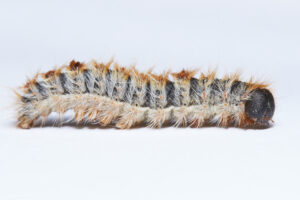
Here, we aim to study – at the national, regional, landscape, and plot scales – the environmental factors (i.e., climate and agricultural practices) that influence biodiversity in agroecosystems. This research includes already the spatio-temporal monitoring of various taxa such as arthropods (beetles, thrips, predatory and phytophagous mites, parasitoid insects), plants, birds, nematodes, soil microorganisms, and symbionts, in natural, agricultural, and forest ecosystems. A significant component of this work employs taxonomic approaches (morphological and molecular) and the characterization of interaction networks (notably through metabarcoding). The goal is to describe communities, detect potentially problematic or new species, describe food webs and other functional links that characterize arthropod communities, and monitor biodiversity on a large scale in a repeatable, rapid, and efficient manner so as to detect changes. We also seek to incorporate other new technologies, including automatic sound and image detectors, remote sensing, and drones, through our collaborations with other research labs (UMRs) within the framework of major structuring projects.
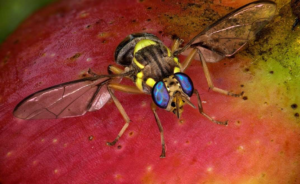
Here, we aim to identify and better understand the biological interactions that allow for the control of pest populations, in order to propose sustainable, tailored, and adaptable solutions for producers, thereby reducing their reliance on pesticides. This work relies on the characterization of ecological interactions to describe and understand often complex relationships (particularly tri-trophic: plant-pest-parasitoid; plant-pest-predator; plant-pest-endosymbiont, competitive, intra-guild predation, etc.). We use field and laboratory experiments to test the effectiveness of biological control agents, particularly to confirm or optimize combinations of predators, parasitoids, competitors, or biocontrol products, which can then be deployed in agricultural fields. Another component of this work involves describing and understanding the population dynamics of pest species (e.g., temporal fluctuations and spatial structure and dynamics), including invasion histories, to contribute to risk prevention programs at different scales. This research includes intensive spatio-temporal demographic and genetic monitoring and detailed characterization of the environment and socio-technical system (e.g., fruit flies), to develop, for example, statistical tools to quantify key demographic parameters (e.g., dispersal) and characterize their relationships with the environmental matrix (demographic and genetic inference, landscape genetics). This work is grounded in an agro-ecological co-design approaches to cropping systems in partnership with agricultural stakeholders and other labs (UMRs) that specialize more specifically in agronomy and socio-economics in Montpellier.
Risk forecasting allows us to anticipate changes in the distribution of harmful organisms, or conditions that favor them, before a major crisis occurs. The goal is to proactively target species or areas requiring increased surveillance, and ultimately limit the application of pesticides or other control measures by targeting small areas before the problem spreads. This work relies on several complementary approaches. Taxonomy and the characterization of the population genetic structure and diversity of harmful species make it possible to characterize traits associated with their harmfulness, identify particularly dangerous populations, trace the geographic origin of incursions, and raise awareness of potential risks. This work requires the integration of information from developing countries, as well as ongoing and effective collaboration, including knowledge transfer and cross-border management. We use statistical and mechanistic modeling to forecast short- and long-term risks related to organisms of agricultural interest, which can be crop pests but also beneficial organisms, and to global changes (climate change and agriculture). Our interactions with the French plant epidemiological surveillance platform (ESV), which gathers all the relevant public institutions, and with the FAO’s anti-locust crisis unit, among others, allow us to interact with different stakeholders for the implementation of large-scale integrated management.
Project manager: Denise Navia
Funding: BIOPOLIS, UM, EU Horizons H2020
This invasion ecology project focus on the multitrophic interactions involving terrestrial arthropods (insects and mites), both phytophagous and predators/parasitoids, and alien plants (invasive or not) in the Azores archipelago.
Main questions addressed are:
On the arhtropod communities associated with alien plants: Do alien plants present in the Azores island host alien herbivore arthropods and what is the associated diversity? Have endemic phytophagous arthropods adapted to invasive plants in the Azores islands and what is the associated diversity?
On the tritrophic interactions: Are tritrophic interactions similar on alien and endemic/naturalized host plants? Do ecosystem anthropogenic influences affect communities and its multitrophic interactions and how?
Project Coordinator: Denise Navia
Funding: Défi-Clé VINID’OCC
Soil mites represent one of the most abundant and diverse groups within the mesofauna. They play a crucial role in interactions with micro-, meso-, and even macrofauna, contributing directly or indirectly to organic matter decomposition, nutrient cycling, hydrology, and the regulation of pest populations. Despite their multifunctional role in agroecosystems, including vineyards, soil mites have been largely overlooked.
This project aims to address this gap through two specific objectives: (i) to evaluate the effects of vineyard diversification (cover crops and agroforestry systems) and management practices (inputs and level of mechanization) on the functional diversity of predatory soil mite communities and their potential prey (collembolans, insects, nematodes); and (ii) to determine the predation of the most common predatory soil mites in vineyards and assess their potential as biological control agents. The study will be conducted within the SALSA experimental system, located at Domaine du Chapitre, Villeneuve-lès-Maguelone (Hérault, France).
https://vinidocc.edu.umontpellier.fr/soutien-a-la-recherche/les-projets-complementaires/

Project manager : Cyril Piou
Funding: French Development Agency (AFD) through the United Nations Food and Agriculture Agency (FAO)
The objectives of this project are:
Project manager: Enric Frago
Funding: ANR PRCE
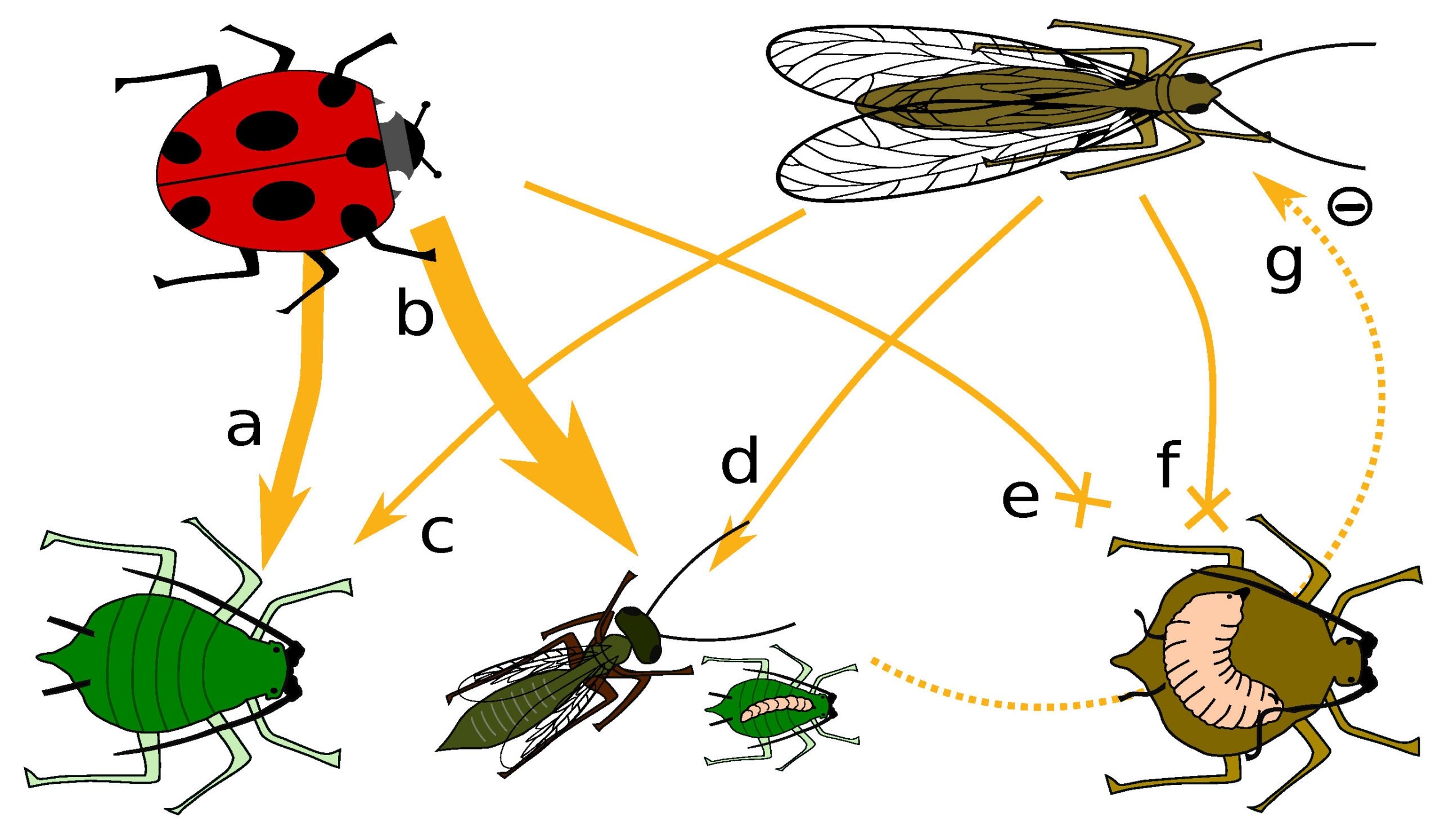
We aim at using natural enemy combinations to find the best cocktails to control aphids and spider-mites. Best cocktails imply better pest suppression, but also long-term stability. We will perform experiments in the laboratory and build theoretical models to find best cocktails that we will validate in the field through mass releases in commercial greenhouses.
https://sites.google.com/site/enricfrago/enemycocktail-project

Project managers: Christine Meynard et Guillaume Fried (LSV)
Funding: Ecophyto II+
Since 2012, the 500 ENI network has been monitoring biodiversity across 500 plots to detect potential non-target effects (ENI in French) of agricultural and plant protection practices. This monitoring network is funded by the DGAL through the OFB, and the network of observers is coordinated by the MNHN and the national agricultural chamber. The associated 500 ENI working group is led by INRAE (Christine N. Meynard) and ANSES (Guillaume Fried) and brings together around fifty participants from various research institutes, chambers of agriculture, FREDONs, the DGAL, and other stakeholders involved in the monitoring. While the primary goal is to leverage the collected data, specific objectives evolve over time. Currently, beyond scientific publications, we are continuing to automate output generation and structure the data to facilitate better sharing and dissemination of results, improved integration with landscape and other data from various sources, and more efficient statistical analysis. Although the project does not have a dedicated website, its results feed into the 500 ENI network EcophytoPIC website.
Project manager: Nicolas Constant (IFV); CBGP contact: Christine Meynard
Funding: PARSADA
Amidst evolving European regulations, the wine industry faces a major challenge: controlling insects—both vectors of Flavescence dorée (FD) and emerging pests—without relying on synthetic insecticides, which are being progressively phased out. Consequently, managing Flavescence dorée requires an innovative, multi-pronged approach. This involves deploying early detection tools to identify the disease early in the season—before visual symptoms appear—and destroying the green parts of infected vines to limit the vector-borne spread of the phytoplasma during the growing season. The project aims to develop survey (modeling) and monitoring tools for all these pests. The CBGP is contributing to this modeling effort regarding emerging grapevine pests. The project also plans to establish national coordination for control efforts (by deploying a network of regional coordinators) and to develop knowledge-transfer tools for industry stakeholders (technicians and winegrowers) as well as for educational purposes.
https://www.vitinnov.fr/Projets/projet_innova-vigne.php

Project managers: Jérôme Enjalbert (GQE) and Aline Fugeray-Scarbel (GAEL), Jean-François Martin
Fundinf: Investissement d’avenir : Cultiver et Protéger Autrement
The MoBiDiv project aims to gain a better understanding of the effects of the use of varietal mixtures on reducing pesticide use and the mechanisms of interaction between plants within mixtures. The project focuses on wheat, peas and forage plants. The aim is to develop tools for selecting varieties specially adapted for use in mixtures. The project will also propose tools to aid decision-making on the choice of mixtures. Finally, the project will study scenarios for the reorganisation of the seed sector and changes in regulations, research funding and the distribution of activities between players, to enable the development of seed mixtures.

Project managers: Adrien Rusch, UMR SAVE and Christine Meynard
Funding: National Plan for Vine Dying-back
This project aims to understand the spatial and temporal dynamics of key endemic and invasive vineyard pest species (e.g., Drosophilidae, Cicadellidae, Lepidoptera). These species belong to families that pose a proven or potential risk to French vineyards. By combining nationwide participatory data collection with a hierarchical statistical modeling approach, we seek to identify the multi-scale environmental variables that explain the presence and population levels of these insects. Analyzing the traits of species that are already established or currently invading will help anticipate future pest invasion risks. For emerging pests—including some that have not yet reached France—we will employ simpler distribution models leveraging global occurrence data. This project is a collaboration between the UMR SAVE (Adrien Rusch), the IFV (Xavier Burgun), and the CBGP (Christine Meynard).
https://sante-agroecologie-vignoble.bordeaux-aquitaine.hub.inrae.fr/nos-outils/observatoire-ovni
Project manager: Enric Frago (CBGP) & Bruno PARIS (ASTREDHOR)
Funding: PARSADA – FranceAgriMer
Thrips are among the major pests in horticulture, and the Trans’Thrips project aims to develop innovative approaches for their management as well as improve the transfer of solutions to professionals. The CBGP is specifically involved in the INTEGRAT and RESIST actions. INTEGRAT will assess, across different scales (micro- and mesocosms), the most effective combinations of biocontrol agents, including pathogens and predators, as well as their optimal conditions for application. RESIST will analyze thrips resistance to control methods, considering both genetic resistance and the role of symbionts.

Project manager: Denise Navia
Funding: PNDV Plan National Dépérissement du Vignoble
The project focuses on the Grapevine Pinot Gris virus pathosystem – the Colomerus vitis-vigne mite vector. The objectives of this project are to answer questions that are still unanswered in order to understand and therefore help manage this ’emergence’: the real link between virus and disease (Koch’s postulates); improving our knowledge of the only vector known to date; and lastly, measuring the real agronomic impact of this virus on the one hand and of Pinot Gris disease on the other.
https://www.plan-deperissement-vigne.fr/recherches/programmes-de-recherche/vigye
